The Power of Fringeship
Why kindness from a stranger might mean more than support from a friend — and what that means for the potential of sharing.

Rea
· 14 min read
This is Part 2 of a two-part essay. Part 1, "How Social Media Stifled Our Need to Share," explored how context collapse, public shaming, and the architecture of social platforms eroded our willingness to be honest — with others and with ourselves.
Part 1 ended with a revelation: we heal when we're heard. But there's something about who hears us that changes everything.
•••
Most of us have heard the parable of the Good Samaritan. A man is beaten and left on the side of the road. A priest passes by. A Levite passes by. Both had reason to help — social obligation, religious duty, proximity. Neither stops.
Then a Samaritan stops.
And this is where the parable's real force lives, because most modern readers miss what a first-century Jewish audience would have understood instantly: Samaritans and Jews were not strangers. They were enemies. Centuries of mutual hostility — religious schism, ethnic contempt, the destruction of each other's temples — had produced a hatred so entrenched that calling someone a Samaritan was among the most devastating insults in the culture.¹
And yet it is the Samaritan — the outsider, the adversary, the person with every reason not to help — who crosses the road, kneels down, and tends to the wounded man's injuries.
The parable has endured for two thousand years, and the reason isn't hard to find. We understand, instinctively, that kindness from someone who chose to give it — who had no obligation, no social contract, no expectation of reciprocity — carries a different weight than kindness that was expected.
It feels more real. Because it was freely given.
The Stranger Paradox
Here is something counterintuitive: people sometimes prefer emotional support from strangers over close friends.
Researchers studying self-disclosure and social support have found that people are especially likely to turn to weak ties — acquaintances, strangers, anonymous listeners — when they feel self-conscious about what they're going through.² With close friends and family, there's an existing relationship to manage. There are expectations, roles, histories.

Admitting you're struggling to someone who already has a fixed idea of who you are can feel like you're letting them down — or worse, shifting the power dynamic. Vulnerability, by definition, means handing someone a piece of your story that you can't take back. And no one likes feeling the loss of control over their own narrative.
With a stranger, that pressure disappears. The empathy isn't obligatory. It's chosen. There's no track record to protect, no role to maintain, no fear that your vulnerability will become a data point in someone's ongoing assessment of you.
One study found that sharing emotions with strangers was, in certain conditions, more satisfying than sharing them with friends — particularly when the emotion involved personal insecurity or shame.³ Strangers offer what friends sometimes can't: a blank slate. No baggage. No judgment shaped by years of knowing you.
This doesn't mean close relationships don't matter. They do — enormously. But it does mean that the common assumption — that the closer the tie, the better the support — isn't always true.
One might even argue that professional support has its own limitation here. As essential as therapy is, the care is contractually obligated. The therapist is paid to listen. A stranger who listens because they chose to? That's a different kind of validation — evidence that your experience matters beyond the circle of people who are personally or professionally invested in you.
Fringeships
In 2025, a team of researchers introduced a concept that gives language to something many of us have felt but never named: the fringeship.⁴
Fringeships sit on the boundary between acquaintance and friend. They're characterized by regular contact in specific settings, a mutual recognition of the connection, a degree of shared fondness — and, crucially, freedom from obligation. The fruit vendor who always gives you an extra slice. The guy in the baseball cap you always nod to at the dog park. The coworker in another department whom you only ever talk to in the elevator, but who somehow always asks the right question.
These aren't deep relationships. But the researchers argue they play a uniquely important role in the full spectrum of human connection — precisely because they're low-stakes. There's no performance required. No history to manage. Just a brief, genuine moment of connection between two people who chose to notice each other.

The pandemic made the value of fringeships painfully clear. When lockdowns eliminated casual encounters — the ambient social fabric of daily life — people didn't just miss their close friends. They missed the elderly neighbor they always held the door open for. The kids taking the same route home from school. The regulars with headphones at the coffee shop who never introduced themselves but always smiled. The familiar strangers. The relationships that lived in the margins.
And when those margins disappeared, something essential went with them. What the World Health Organization now calls a global loneliness epidemic didn't begin with the pandemic — but the pandemic made its shape unmistakable. Not just the absence of deep connection, but the erosion of a particular kind of intimacy — the unforced closeness that emerges when people share a space repeatedly, without expectation, and occasionally surprise each other with something real.
The Voice Channel
For years, I played games online with people I'd never met. We didn't even know each other's real names most of the time. Didn't know what anyone did for a living, or where they lived, or what their lives looked like outside the game. What we knew was this: we had the same sense of humor, and we played on the same team. And somehow, that was enough.
We didn't know all the happenings of each other's lives. But sometimes, unprompted, someone would choose to share. A rough day at work. A hard breakup they'd initiated because it was time. A family situation that was wearing them down. And we'd listen. We'd make space.
One evening, someone who only played with us occasionally — a lawyer from overseas, who once told us he liked gaming with us because we helped improve his conversational English for his American clients — got into the voice channel and announced he was going to propose to his girlfriend.
He told us how they'd met a year ago. His voice was giddy as he described how he was going to do it, and where he was going to take her. His accent was stronger with every word, barely concealed by excitement.
"I just really wanted to tell someone."
We listened raptly.
Truth be told, we didn't know him well. But every single person in that channel — five or six of us — could feel the energy shift. There was fizzy quality to his joy. A radiance to his laughter.
We asked about her personality. We asked what they liked to do together. We asked if they had plans for children. We asked if they had plans for dinner. We learned more about him that night than we'd ever known or thought to ask in all the games before.
And it felt deeply intimate.
Not because we suddenly became close friends. But because he chose to share something real with us — people who had no obligation to care — and we chose to receive it.

That's the power of fringeship. A connection built not on biography but on presence. On showing up, again and again, to the same room — being open to give and receive, and often surprising ourselves with what we get back.
I know people who've maintained friendships like this for over a decade. Best friends who've never met in person. People who would drop everything if one of them needed help — and have. The bond wasn't built on knowing everything about each other. It was built on repeated acts of choosing to be in the same place, at the same time, for no reason other than wanting to.
Feeling Good from Doing Good
There's a neurological dimension to this.
Research on altruism has found that the brain responds differently to acts of kindness depending on the context. When someone helps a stranger — with no expectation of reciprocity, no social obligation, completely unchoreographed — the brain's reward circuitry lights up in a distinctive pattern, involving the nucleus accumbens, the anterior cingulate cortex, and the medial prefrontal cortex.⁵ The helper experiences a measurable surge of dopamine and serotonin.
And what matters is what happens on both sides of the exchange.
When kindness arrives from someone who had no reason to give it — when a Samaritan crosses the road to tend your wounds — the experience disrupts a narrative that shame works hard to maintain: no one cares. I'm alone in this. My pain is invisible. A stranger's kindness says, instead: someone who owes you nothing saw you, and chose to respond.
That's not just comforting. It's validation. Evidence that your experience matters beyond the circle of people who are personally or professionally obligated to care. Quite the opposite of public shaming, this fosters belonging in the larger community.
The kind of faith that many of us, somewhere in adulthood, traded — brick by brick — for walls of cynicism and distrust.
For the person giving that kindness, the act itself generates meaning. A study published in Psychological Science found that people who help total strangers are generally viewed as more morally trustworthy than those who help family members.⁶ We intuitively understand that the most meaningful kindness is the kind that was freely given.
And a large meta-analysis found that prosocial behavior — helping others — produces a stronger sense of purpose and well-being than almost any other positive activity, especially when the help is freely chosen.⁷ Meaning it benefits the helper to help.
This creates a possibility that's easy to overlook: in the right space, the act of witnessing someone's vulnerability and the act of being witnessed can both be healing by the same stroke. That’s poetic justice.
Do People Actually Choose Kindness?
This is the part of the argument that requires honesty. Everything we've described — the power of stranger kindness, the unique intimacy of fringeships, the healing potential of being witnessed by someone with no obligation — rests on an assumption: that when given the freedom to choose, people will choose kindness.
Is that true?

The cynical answer is no. Anonymity breeds cruelty. Comment sections prove it. Give people a mask and they'll show you their worst.
But the research tells a more complicated story.
A 2025 study published in Personality and Individual Differences found that anonymity can actually boost prosocial behavior online — challenging the assumption that removing identity always leads to toxicity.⁸ The researchers found that perceived social fairness and well-being mediate the relationship: when people feel the space is fair and their own well-being is supported, anonymity frees them to be more generous, not less.
This aligns with something Brown observed in her research on belonging: the difference between fitting in and true belonging.⁹ Fitting in requires performing. Belonging requires being yourself.
And what do people do with that choice?
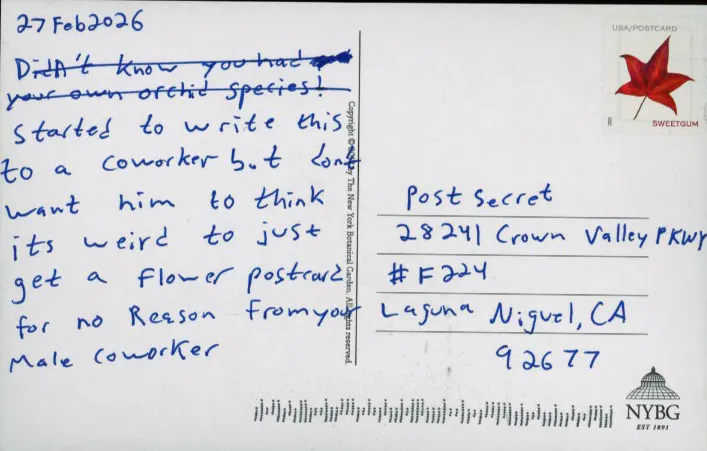
Frank Warren found out. In 2004, he printed 3,000 self-addressed postcards and distributed them to strangers, asking each person to share a secret they'd never told anyone. He expected a trickle. What he got was a flood. PostSecret became the most visited advertisement-free blog in the world, with more than half a million postcards now on display at the Smithsonian.¹⁰ People didn't just share. They shared with startling honesty — and the community that formed around those anonymous confessions was overwhelmingly one of empathy, not cruelty.
Helena Dea Bala discovered something similar when she began posting on Craigslist with a simple offer: "I'll listen." Strangers met her in coffee shops and told her their deepest truths — stories of addiction, grief, shame, joy. The resulting book, Craigslist Confessional, became a testament to what happens when you create a space where the cost of honesty is zero.¹¹
And then there's the Pandemic Journaling Project, which we discussed in Part 1 — an open platform that wasn't designed as therapy but unofficially became one, because people who were given a safe space to be honest chose to be honest. And the community that formed around that honesty chose empathy.
The pattern is consistent: when the architecture of a space removes the incentives for performance and the penalties for vulnerability — when there's no audience to impress and no mob to fear — people tend toward connection, not cruelty. Not always. Not perfectly. But reliably enough that it matters.
A Moral Obligation
In Part 1, we named Brown's three conditions in which shame thrives: secrecy, silence, and judgment.
Social media provides all three at scale. And with the rise of platforms that reward performance, punish vulnerability, and flatten audience into jury — there is a moral obligation to build spaces that counterbalance the engine of a growing loneliness epidemic.

These are not spaces we build once. Just as the problem isn't one we solve and walk away from. It's a force that requires continuous community support, continuous buy-in, continuous showing up — the way you show up to a running club or a beach cleanup or a gaming group on a Tuesday night. You do it because the alternative — curating an online presence, continuing to perform, continuing to let the spiral of silence reach all the way down to your core — has a cost you can no longer afford to ignore.
What does a space creating counterbalance look like?
- private, but not secret — where you can own your truth, write it down, and acknowledge it to yourself. Journaling solves the secrecy problem. Not by broadcasting, but by breaking the internal silence.
- safe, but not silent — where sharing is possible without the fear of a flattened audience. Where you can choose to let your words be seen. No profiles. No follower counts. No algorithms deciding who sees what.
- open, but not judged — where the people who respond aren't performing their empathy for a public audience, but offering it privately, human to human. No controversy farmers. No critics. Just another person, meeting you where you are.
These are the principles that sparked a moral obligation to create Jurno — a space for safe journaling, zero-pressure sharing, and the ability to read and connect with others through private letters. Read more about the product philosophy behind Jurno →

The practice works in three movements:
We own our truth. Notice it, accept it, write it down. That's already a form of sharing, with ourselves.
We choose to share it. Not for applause. Not for engagement. Just to put it out there. Even if no one reads it, you've placed your truth in the world. That’s freeing.
We find resonance. We read what others write, and something shifts. We recognize that vulnerability comes in many forms — different lives, different struggles, the same human need to be known.
The situations may be different, but the emotions are all human, and we all have them. It creates a feedback loop. Their honesty deepens our own. Our honesty gives them permission to deepen theirs. And almost imperceptibly, we move from collective judgment to collective understanding.
The Road Ahead
I should say this plainly: social media is not evil. I don’t mean to vilify it. It connected people who would never have found each other. It gave voice to movements that changed the world. It made the planet feel smaller and more knowable.
But it had a side effect. And that side effect — the erosion of safe, honest sharing — is something we must address. Urgently.

I’m not going to pretend the tension resolves neatly. The low-grace culture is still here. The instinct to self-censor is deep, and it won't unlearn itself overnight. Rebuilding trust in being seen — whether by a friend, a therapist, a journaling circle, or a stranger on the other side of a screen — is slow, and it requires spaces designed for honesty rather than engagement.
But here's what I believe: the impulse that drove Augustine to write his Confessions, that drove Rousseau to bare himself to the world, that drove pandemic journal sharers to say I'm not okay and mean it — that impulse is still alive. It didn't go away. It just went underground.
And it doesn't need a massive audience to resurface. It needs one person. One witness. One stranger who chose to listen.
That might be enough to start.
Sources
¹ Luke 10:25–37, New International Version. The Parable of the Good Samaritan. For historical context on Jewish-Samaritan hostility, see: Schiffman, L. H. (1992). "The Samaritans." Encyclopedia of the Dead Sea Scrolls. Oxford University Press.
² Moreton, J. (2023). Social support from weak ties: Insight from the literature on minimal social interactions. Social and Personality Psychology Compass, 17(4), e12729.
³ Dubé, L., & Bhosale, S. (2015). When sharing consumption emotions with strangers is more satisfying than sharing them with friends. Journal of Consumer Research.
⁴ Fingerman, K. L., Birditt, K. S., Fiori, K. L., Hall, J., Huxhold, O., Rauer, A., Sandstrom, G. M., & Sprecher, S. (2025). More than an acquaintance, less than a friend: Fringeships in everyday life. Current Directions in Psychological Science, 34(2).
⁵ Georgetown University (2019). The neuroscience behind superhuman acts of generosity. Georgetown University News. See also: Vekaria, K. M., et al. (2017). Altruistic behavior: Mapping responses in the brain. PMC.
⁶ McManus, R. M., et al. (2020). What makes a "Good Samaritan" good? Psychological Science.
⁷ Curry, O. S., et al. (2018). Happy to help? A systematic review and meta-analysis of the effects of performing acts of kindness on the well-being of the actor. Journal of Experimental Social Psychology, 76, 320–329.
⁸ Yang, P., et al. (2025). Anonymity as a catalyst for good: Linking social media anonymity to prosocial behavior. Personality and Individual Differences, 236.
⁹ Brown, B. (2017). Braving the Wilderness: The Quest for True Belonging and the Courage to Stand Alone. Random House.
¹⁰ Warren, F. (2005). PostSecret: Extraordinary Confessions from Ordinary Lives. William Morrow.
¹¹ Bala, H. D. (2020). Craigslist Confessional: A Collection of Secrets from Anonymous Strangers. Gallery Books.
About the Author
Hi! I'm Rea. I write, draw, and code out of my studio in LA. I research and ponder wellness, expression, and the science of belonging.


